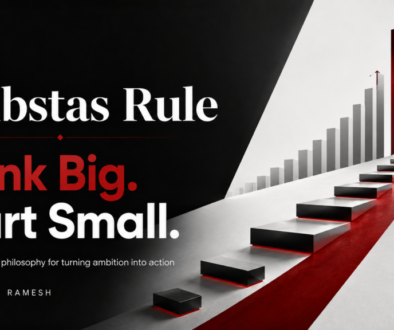
The Strategy of the Plastic Chair: Why Your Big Ambitions Need Micro-Actions

There is a strange contradiction in entrepreneurship.
We are constantly told to think big.
Build the next big company.
Create a five-year vision.
Enter multiple markets.
Build a great team.
Create world-class infrastructure.
Automate everything.
Scale.
I believe in thinking big. In fact, Think Big and Start Small has been at the heart of Thibstas from the beginning.
But there is something important I have learned through actually building businesses:
Thinking big does not mean starting big.
That misunderstanding kills more ideas than a lack of ambition ever will.
When the size of your first step becomes as large as the size of your vision, you create enormous resistance before the journey has even begun.
You start thinking you need an office.
Then employees.
Then software.
Then investment.
Then branding.
Then processes.
Then automation.
Then the perfect launch.
Suddenly, the idea that excited you has become a massive project that needs money, people, infrastructure and months of preparation before a single customer has even paid you.
That is where I believe founders need to understand what I call:
The Plastic Chair Phase
The plastic chair represents something very simple to me.
Start with what you have.
You don’t need the perfect office to start a company.
Sometimes you need a plastic chair, a table, a laptop, a phone and the willingness to solve someone’s problem.
The plastic chair isn’t literally about furniture.
It’s a philosophy.
It represents the stage where your ambition is much bigger than your infrastructure.
And there is absolutely nothing wrong with that.
In fact, I think it is one of the most important stages of building anything meaningful.
Because during this stage, you are forced to understand the business without hiding behind complexity.
You talk to customers yourself.
You sell.
You deliver.
You make mistakes.
You understand where the money comes from.
You understand what customers actually care about.
You discover what doesn’t work.
And most importantly, you learn before you scale.
I would rather discover that an idea doesn’t work while sitting on a ₹500 plastic chair than discover it after building a ₹50 lakh infrastructure around it.
That is the difference between small execution and small thinking.
They are not the same thing.
Think Big. Start Small.
This idea eventually became the foundation of what I call The Thibstas Rule.
The philosophy is simple:
Think Big → Start Small → Act → Learn → Repeat → Systemise → Scale → Begin Again
Each stage matters.
And skipping stages creates problems later.
Think Big
I never want people to reduce their ambition simply because their current resources are limited.
Your bank balance today should not determine the maximum size of your imagination.
Think about the company you genuinely want to create.
Think about the impact.
Think about the customers.
Think about the technology.
Think about what the business could become ten or twenty years from now.
Don’t negotiate with your imagination too early.
But once you’ve thought big, come back to reality.
Then ask:
What is the smallest thing I can do today that moves me toward that future?
That’s where entrepreneurship actually begins.
Start Small
Suppose your dream is to build India’s largest education company.
You don’t need to begin by building an app.
Teach ten students.
If you want to create a global consulting company, you don’t need offices in five countries.
Get one client.
If you want to build software, you may not need to develop the complete platform first.
Find out whether people actually have the problem.
If you want to become a creator, don’t spend three months designing a studio before publishing anything.
Record the first video.
We often use preparation to protect ourselves from the discomfort of execution.
Starting small removes that excuse.
Act
This stage sounds obvious.
It isn’t.
I have seen people spend years discussing ideas they could have tested in a weekend.
Planning feels productive because nothing can reject you while you’re planning.
The market can.
A customer can.
Reality can.
That’s precisely why action matters.
The moment your idea enters the real world, imagination becomes information.
Someone buys.
Or they don’t.
Someone responds.
Or they ignore you.
Someone uses the product differently from how you expected.
Every action gives you information that another planning document cannot.
Learn
This is where failure becomes useful.
A failed experiment isn’t necessarily a failed business.
It might simply be information.
Maybe the price was wrong.
Maybe the customer was wrong.
Maybe the product was difficult to understand.
Maybe your sales process failed.
Maybe the market simply doesn’t care.
You need to know which one.
The objective of starting small is not merely to save money.
It is to make learning inexpensive.
That’s an important distinction.
Repeat
One experiment tells you something.
Repeated experiments reveal patterns.
You improve the offer.
Try again.
Change the pitch.
Try again.
Improve delivery.
Try again.
Talk to different customers.
Try again.
Eventually, something starts working repeatedly.
Now you have something much more valuable than an idea.
You have evidence.
And evidence is what should earn the right to scale.
Systemise
This is where I think many founders make another mistake.
Something starts working and immediately they want to automate it.
I follow a different principle:
Never Automate Confusion.
My preferred sequence is:
Do Manually → Understand → Simplify → Document → Systemise → Automate → Scale
If you automate a broken process, you don’t magically create an efficient company.
You create a faster broken process.
Do it manually first.
Understand where the friction is.
Remove unnecessary steps.
Document what remains.
Make it repeatable.
Then bring technology into the equation.
Automation should multiply understanding.
Not replace it.
Scale
Only now does scale become interesting.
Because you’re no longer throwing resources at a theory.
You’re investing resources into something that has already shown signs of working.
Hire.
Advertise.
Automate.
Expand.
Build infrastructure.
Increase capacity.
Enter new markets.
But do it because demand and evidence justify the investment—not because you want to look like a big company.
There is a dangerous temptation in entrepreneurship to look successful before becoming successful.
Expensive offices.
Large teams.
Unnecessary subscriptions.
Complex organisational structures.
Fancy designations.
All of these can create the appearance of scale.
But appearances don’t create resilient companies.
Economics do.
Sell Before You Scale
One principle I keep returning to is:
Sell before you scale.
Your first customer can teach you more than months of internal discussions.
Revenue is not the only form of validation, but it is a brutally honest one.
Someone saying:
“That’s a great idea”
is very different from someone saying:
“Where do I pay?”
Entrepreneurs need to understand that difference.
Build enough to test.
Sell enough to validate.
Learn enough to improve.
Then invest enough to grow.
Begin Again
This is the part of the Thibstas Rule that I think is easiest to overlook.
After Scale comes:
Begin Again.
Because no system remains perfect forever.
Markets change.
Technology changes.
Customers change.
Competitors change.
Your own understanding changes.
Eventually, even a successful company must become a beginner again.
Think Big.
Start Small.
Act.
Learn.
Repeat.
Systemise.
Scale.
And then return to curiosity.
That cycle never really ends.
Why I Call It the Plastic Chair Strategy
As founders, we sometimes become embarrassed by small beginnings.
We shouldn’t.
The plastic chair phase is where you earn your understanding.
There is something powerful about being able to say:
We don’t have everything yet. But we have enough to start.
That mindset gives you speed without recklessness.
Ambition without unnecessary overhead.
Experimentation without catastrophic risk.
And growth without pretending that you already know everything.
I would rather build a company that looks small and understands its customers than a company that looks impressive and doesn’t understand its economics.
The plastic chair can always be replaced later.
A fundamentally broken business is much harder to replace.
Your Next 24 Hours Matter More Than Your Next Five Years
So here’s the question I would leave you with.
What are you trying to build?
Think as big as you possibly can.
Don’t reduce the vision.
Now ask:
What is the smallest meaningful action I can take toward it in the next 24 hours?
Not next quarter.
Not after funding.
Not after hiring.
Not once the website is ready.
Tomorrow.
Make the call.
Create the prototype.
Talk to the customer.
Publish the page.
Send the proposal.
Test the idea.
Make the first sale.
Sit on the plastic chair if necessary.
Because big companies aren’t created by taking one enormous step.
They’re created by taking thousands of intelligent small ones in the right direction.
Think Big.
Start Small.
Then act.
Everything else can be built from there.
— Sai Teja Ramesh
Founder, Thibstas | Creator of The Thibstas Rule