Belief Builds Before Results Arrive: The Difference Between Founder Conviction and Delusion

Every business begins with something that cannot yet be proven. The founder’s job is to believe long enough to test it—not blindly enough to ignore reality.
Before Anyone Else Believes, Someone Has To
Every business begins in an uncomfortable place.
There are no customers yet.
No revenue.
No case studies.
No testimonials.
No proof that the market wants what you’re building.
Sometimes there isn’t even a finished product.
There is simply an idea and someone who believes strongly enough to act on it.
That person is usually the founder.
This is why I believe:
Belief builds before results arrive.
But there is an important second half to that philosophy.
Belief should give you enough courage to run the experiment.
It should never give you permission to ignore the result.
That distinction separates conviction from delusion.
And I think every entrepreneur needs to understand it.
Every Startup Begins as an Unproven Argument
Think about what you’re actually doing when you start a company.
You are making an argument about the future.
You are saying:
I believe this problem matters.
I believe these people experience it.
I believe I can create a better solution.
I believe someone will pay for it.
I believe I can deliver it sustainably.
I believe enough people will care for this to become a business.
Initially, almost none of this is proven.
That’s why entrepreneurship requires belief.
If founders demanded certainty before acting, almost nothing new would ever be created.
But there is a danger.
The same belief that gives a founder courage can eventually make them deaf.
They become emotionally attached to the original idea.
Customers disagree.
The founder keeps believing.
Sales don’t happen.
The founder keeps believing.
People use the product differently.
The founder keeps insisting they are wrong.
Money disappears.
The founder calls it perseverance.
At some point, belief stops being an asset.
It becomes a shield protecting the founder from reality.
The Two Jobs of Belief
I think founder belief has only two legitimate jobs.
Job 1: Get You Into the Arena
Belief gives you enough courage to start before certainty exists.
Job 2: Keep You There Long Enough to Learn
Belief prevents one rejection, one bad month or one failed experiment from immediately destroying the mission.
That’s it.
Belief should fund the experiment emotionally.
Evidence should decide what happens next.
I think about it this way:
Belief → Action → Evidence → Decision
Not:
Belief → Belief → More Belief → Bankruptcy
That sounds obvious when written down.
In reality, founders cross that line surprisingly often.
Believe in the Mission. Question the Method.
This has become one of the most useful distinctions for me.
Your mission can remain stubborn.
Your method should remain flexible.
Suppose your mission is to improve access to education.
That’s the belief.
You decide to build an app.
That’s a method.
If customers don’t want the app, it doesn’t automatically mean the mission was wrong.
Maybe the delivery mechanism was wrong.
Maybe students want live classes.
Maybe institutions are the real buyer.
Maybe WhatsApp works better than another application.
Maybe your pricing is wrong.
Maybe your target segment is wrong.
The founder who confuses mission with method becomes trapped.
They start defending the product because abandoning it feels like abandoning the dream.
It isn’t.
Sometimes changing direction is how you protect the dream.
Be stubborn about the problem. Be flexible about the solution.
The Founder Has to Believe First
There will be periods where other people simply don’t see what you see.
Your family may not understand it.
Employees may join after the uncertainty has reduced.
Customers arrive after something usable exists.
Investors often become interested after traction appears.
The public notices after momentum becomes visible.
But someone has to operate before all of that.
That’s the lonely privilege of being a founder.
You have to look at something that doesn’t exist and behave as though it could.
Not will.
Could.
That word matters.
Because entrepreneurship isn’t certainty.
It’s probability combined with action.
You aren’t proving that your vision must happen.
You’re giving it enough opportunities to become true.
Conviction Is Not Confidence
I also think we confuse conviction with confidence.
Confidence says:
“I know this will work.”
Conviction says:
“I believe this matters enough to find out.”
I prefer conviction.
Because confidence can disappear.
You can wake up uncertain.
A customer can reject you.
A competitor can launch something better.
Revenue can fall.
A trusted employee can leave.
You may question yourself.
None of that necessarily destroys conviction.
Conviction isn’t the absence of doubt.
It is the willingness to continue investigating despite doubt.
That’s much more useful to a founder than motivational certainty.
The Evidence Ladder
One of the ways I think founders can protect themselves from delusion is by deliberately climbing what I call an Evidence Ladder.
Your idea should gradually earn stronger forms of proof.
Level 1 — Personal Observation
You notice a problem.
Useful, but weak.
Level 2 — Conversations
Other people tell you they experience the same problem.
Better.
Level 3 — Behaviour
People actively try your solution.
Now things become interesting.
Level 4 — Payment
Someone gives you money.
This is substantially stronger evidence.
Level 5 — Repeated Payment
Customers return or continue paying.
Now you’re seeing sustained value.
Level 6 — Referral
Customers voluntarily bring other customers.
Your value is becoming transferable.
Level 7 — Repeatable Acquisition
You can predictably acquire customers through a process.
Now you may have a business engine.
Level 8 — Scalable Economics
Growth produces attractive economics rather than simply larger losses.
Now scale becomes rational.
Notice what happens as you move upward.
Belief becomes less important.
Evidence becomes more important.
At the beginning, belief may carry 90% of the weight.
Later, the business should not need the founder’s faith to prove that it works.
The numbers, customers and systems should begin speaking for themselves.
Don’t Ask People Whether They Like Your Idea
One of the weakest forms of validation is asking:
“Do you think this is a good idea?”
Most people are polite.
Friends are even worse.
They don’t want to hurt you.
So they say:
“That’s interesting.”
“You should definitely do it.”
“I would use that.”
Maybe.
The better question is behavioural.
Will you try it?
Will you introduce me to someone?
Will you give me your email?
Will you spend twenty minutes testing it?
Will you pre-order?
Will you pay?
People’s opinions are useful.
Their behaviour is usually more useful.
I would rather have five customers paying for an ugly first version than 5,000 people telling me my idea sounds amazing.
The Market Doesn’t Care How Much You Sacrificed
This can be painful.
You may have spent two years building something.
The market doesn’t owe you demand because you worked hard.
You may have invested your savings.
The customer doesn’t owe you a purchase because you took a risk.
You may deeply believe in the product.
Reality isn’t required to agree with your belief.
That sounds harsh.
I actually find it liberating.
Because once you accept it, you stop treating rejection as a judgment of your identity.
The experiment failed.
Not necessarily you.
The offer failed.
Not necessarily the mission.
The price failed.
Not necessarily the product.
Your job is to discover what exactly failed.
That turns disappointment into information.
The Cost-of-Belief Rule
I use another mental model here:
The weaker the evidence, the smaller the bet should be.
If all you have is an idea, don’t bet the entire company.
Run a small experiment.
If ten customers show interest, increase the bet slightly.
If people start paying, increase it again.
If customers stay, refer others and produce healthy economics, increase it again.
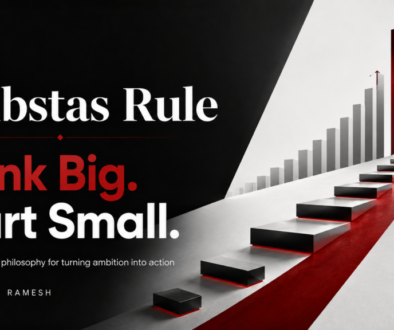
This connects directly with the broader philosophy of The Thibstas Rule:
Think Big. Start Small.
Your vision can be enormous.
Your first financial commitment doesn’t need to be.
Belief gives you permission to start.
It doesn’t give you permission to be reckless.
Learn to Kill Your Favourite Ideas
Founders naturally become attached to their ideas.
We created them.
We defended them.
We imagined their future.
Sometimes we even built our identity around them.
That’s precisely why we need mechanisms that can challenge us.
Ask:
What evidence would prove me wrong?
This is a powerful question.
Most founders ask:
“How can I prove this works?”
Try asking:
“What would convince me this doesn’t work?”
Now you have a falsifiable experiment.
For example:
“If 100 qualified prospects see this offer and fewer than two are willing to have a serious sales conversation, I will revisit the positioning.”
That’s useful.
Because you’ve created a condition where reality can defeat your assumption.
Without that condition, every result can be rationalised.
“No one bought because the market isn’t ready.”
“The ad failed because people don’t understand innovation.”
“Customers aren’t using it because they’re resistant to change.”
Maybe.
Or perhaps the product isn’t good enough.
Founders need enough humility to consider that possibility.
Persistence and Pivoting Are Not Opposites
We celebrate founders who never gave up.
But we often misunderstand what they didn’t give up on.
Many successful entrepreneurs changed:
Products.
Markets.
Business models.
Pricing.
Distribution.
Teams.
Technology.
Positioning.
What they didn’t abandon was the pursuit of a meaningful problem.
Persistence does not mean repeating exactly the same action indefinitely.
Sometimes persistence looks like changing the method for the twentieth time.
That’s why Repeat comes after Learn in The Thibstas Rule.
Act.
Learn.
Then repeat.
If you remove Learn, repetition becomes stubbornness.
Belief Should Shrink as Evidence Grows
This might sound strange.
But I believe a mature business should require less founder belief than an early-stage business.
In the beginning:
“I believe customers need this.”
Later:
“Customers are buying this.”
In the beginning:
“I believe we can acquire customers.”
Later:
“Our acquisition data shows how.”
In the beginning:
“I believe people will stay.”
Later:
“Our retention numbers demonstrate it.”
In the beginning:
“I believe this can scale.”
Later:
“Our economics demonstrate whether it can.”
This is progress.
The objective isn’t to become permanently dependent on optimism.
The objective is to convert belief into evidence.
Where Delusion Begins
For me, founder delusion begins when someone repeatedly chooses their preferred story over available evidence.
There are warning signs.
You blame customers for not understanding.
You keep changing the explanation but never question the offer.
You spend significantly more without learning significantly more.
You celebrate attention while ignoring revenue.
You call every failure “too early.”
You refuse to define what would make you stop.
You surround yourself only with people who agree.
You confuse sunk cost with future opportunity.
And perhaps the biggest one:
You stop being curious.
Curiosity protects founders from ego.
Instead of saying:
“The market is wrong.”
Ask:
“Why is the market behaving this way?”
That single change can save enormous amounts of time and money.
The Founder Conviction Matrix
I think about decisions across two dimensions:
Belief and Evidence.
High Belief + Low Evidence
Experiment.
This is where most startups begin.
Keep the bet small and learn quickly.
High Belief + High Evidence
Scale.
Now conviction and reality are aligned.
Low Belief + High Evidence
Investigate yourself.
The opportunity may be real even if you’ve emotionally lost interest. Decide whether someone else should lead it or whether your assumptions need updating.
Low Belief + Low Evidence
Stop.
Not every idea deserves another year of your life.
This framework prevents us from treating persistence as an automatic virtue.
The Real Job of an Entrepreneur
I don’t think entrepreneurship is about predicting the future correctly.
Very few people can.
I think it’s about constructing a process that allows you to discover the future cheaply enough to survive being wrong.
That’s why the Thibstas Rule doesn’t stop at Think Big.
It moves.
Think Big.
Create the possibility.
Start Small.
Reduce the cost of being wrong.
Act.
Enter reality.
Learn.
Listen to what reality tells you.
Repeat.
Improve the experiment.
Systemise.
Capture what consistently works.
Scale.
Multiply evidence, not assumptions.
Begin Again.
Because the next level contains new uncertainty.
Belief begins the cycle.
Learning keeps it honest.
Final Thought: Believe Enough to Begin. Stay Humble Enough to Change.
There will always be a moment before proof.
Someone has to cross it.
That’s where founders live.
You have to believe in things other people cannot yet see.
You have to invest before certainty.
You have to move while questions remain unanswered.
You have to endure periods where the scoreboard doesn’t validate you.
But don’t turn belief into blindness.
Your vision deserves courage.
Your execution deserves evidence.
Your customers deserve attention.
And reality deserves the final vote.
So believe aggressively.
Experiment intelligently.
Listen carefully.
Change when necessary.
Continue when the evidence earns continuation.
Because the strongest founder isn’t the person who is always certain they are right.
It’s the person who can believe deeply enough to begin—
and remain humble enough to discover where they were wrong.
Belief builds before results arrive.
But eventually, results must arrive.
Think Big. Start Small.
— Sai Teja Ramesh
Founder & CEO, Thibstas Private Limited
Author, The Thibstas Rule — Think Big. Start Small.